Corporate
Sustainability
Products & Solutions
Investors
Careers
Contact Us
Menu
We have provided accessibility tools on our website that will ease user experience. The Accessibility tool will help you to increase/decrease font size, change different contrast scheme on our website.
You can locate accessibility tools
at the extreme right at the top of our website.
If you have low vision, colour vision, you can increase the font size of the text and can opt for a different contrast scheme throughout our website. You can do this by clicking the accessibility tools icon at the extreme right at the top of our website and choose from the different font sizes and different color contrasts.
Further you can select text to speak it. Additionally, you can turn ON/OFF the text-to-audio functionality in the website for the text to speak it. If you are not able to see images/pictures properly on the website you can hover on the images to listen to the image description.
If you have selected the text to speak and you no longer want to listen to an audio, you can click on the Cancel Audio button located on the right-hand side and it will stops playing the speech.
At any point, you can click the ‘Reset’ button (below the font size options) to set the website back to its default mode.
We have provided accessibility tools on our website that will ease user experience. The Accessibility tool will help you to increase/decrease font size, change different contrast scheme on our website.
You can locate accessibility tools
at the extreme right at the top of our website.
If you have colour vision deficiency, you can opt for a different contrast scheme on our website. You can do this by clicking the accessibility tools icon at the extreme right at the top of our website and choose from the different color contrasts.
Additionally, you can turn ON/OFF the text-to-audio functionality in the website for the text to speak it. If you are not able to see images/pictures properly on the website you can hover on the images to listen to the image description.
At any point, you can click the ‘Reset’ button (below the font size options) to set the website back to its default mode.
If you have any kind of hearing impairment such as partial or complete hearing loss, you will be able to see the transcripts/captions (sub-titles) for all the videos on our website and view along. You can do this by clicking on the ‘cc’ option on the bottom right side of the video box.
For any other kind of hearing impairment, you will be able to see the transcripts/captions (sub-titles) for all the videos on our website and view along.
EXPLORESometimes, when we look at the Indian growth story, it's easy to forget that the country is only 71 years old... in its current form, that is. Wherever we look, the pace of change is impressive - our literacy numbers have seen a sea change, our urban centres are hubs of economic activity, we're a nuclear power, and four years ago, we put an orbiter around Mars. It's pretty impressive!
However, like all developing countries, India too has pockets where the pace of change has a lot of untapped potential. When we gained our independence in 1947, 72% of our population was engaged in agriculture, which brought in nearly 50% of our income. Today, we still have 60% of our people sustained by agriculture, but it only contributes to 17% of our income. In the intervening years, the GDP has grown significantly, driven by explosive growth in other sectors; and while agricultural income has increased, it hasn't kept pace with other sectors.
We did have an immense boost to agriculture during the 60s with the Green Revolution. High Yielding Variety seeds, use of tractors and other mechanisations, smarter irrigation, as well as the use of pesticides and fertilizers, saw the farmers in Punjab, Haryana and Uttar Pradesh reap impressive results. As a country, we became self-sufficient in food grains, and have stayed that way since then. However, it must be noted that the food grain farmers who benefited the most, had large farms and holdings. For smaller farmers, the gain wasn't as much, as they didn't have the resources to make the investments in the first place.
Also, in India, it isn't the food grain farmer that earns the most. Farmers engaged in horticultural crops (fruit, vegetables, spices and flowers) can often earn significantly more, sometimes as much as 30 times more. The risks of spoilage though, is what keeps farmers away from horticulture. Currently, we lose a third of our horticultural produce to spoilage (84 Million Tonnes). This is largely driven by the lack of cold storage facilities, cold vans, packing houses and ripening chambers. While the Government's efforts in this area are immense, there exists another potential solution to the problem: food preservation.
Indian farmers are familiar with the practices of drying, powdering and pickling; and while these methods significantly boost farmer incomes, they can't be applied at scale. Canning, however, can be! The process of canning itself is pretty simple and it maintains the nutritive value of the produce. Most studies have shown that the nutritive value of canned produce (especially those canned onsite) exceeds that of "fresh produce" that has actually travelled a few hundred miles in open trucks, and stored in unrefrigerated facilities before reaching our tables. Also, it has the benefit of not being touched by chemical preservatives.
The potential for canning horticultural produce in India stands at 131 million tonnes per year; what's holding it back, is the lack of the infrastructure... we simply don't have the number of canning facilities required to make this a reality. Plus, there is the problem of transportation to these facilities.

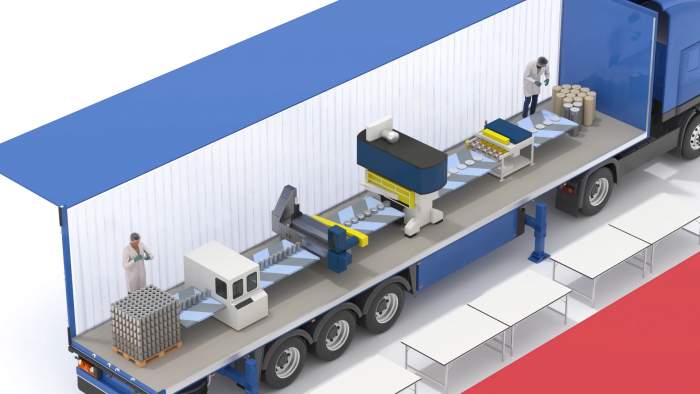
Which is why we're so excited about Tata Steel's Mobile Canning solution! What started out as an attempt to further streamline the canning production line, has grown into a truly future facing project. Tata Steel's Protact® laminated steel was the starting point - the three-layer polymer coating system on Protact® results in a canning process that is five whole steps shorter, and one that uses no water. Now that they had a shorter process, they decided to refine it some more, and see if they could take it out of the factory itself. The result? Tata Steel's Mobile Canning trucks.
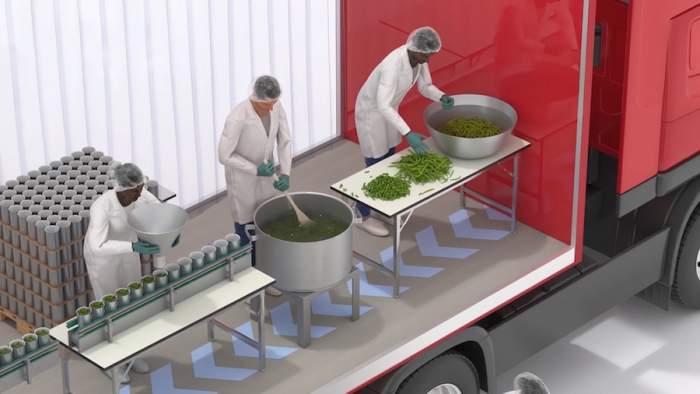
No, you read that right! Two trucks - one that produces the cans onsite from Protact® disks, and another that fills the cans with produce, and then seam, sterilise and label them as well! Quality control is built in: produce is sorted, cleaned, prepared for canning, and must pass the final visual inspection before being filled into cans. The trucks are self-powered, and as there is no water involved in the can making process, there are no external dependencies that can trip up the operation. The mobile trucks can roll up to the farm itself, produce the cans, then can the produce, and move on to the next farm. Simple.
Obviously, this is a game changer for farmers. Not only can they prevent spoilage and protect their income, they can also gain valuable skills. Canning serves as a gateway to other, more value-added methods of preservation. Moreover, it will give them their power back - they will be able to ride out price fluctuations once spoilage isn't an issue, and they won't have to rely on the expensive and often exploitative transportation and storage provided by middlemen! Bumper harvests will finally be a cause for real celebration. With increased incomes, farmers could also explore creating their own cooperatives: capex will be low, as basic storage sheds and open trucks will do just fine for canned goods.
Should we see increased adoption, it will offer a unique opportunity for the Government to introduce vegetables and fruit into the public distribution system. It will also go a long way in augmenting farmer income (which by itself helps with socio-economic issues like income disparity and urban migration) and support the move from producing food grains to growing more profitable horticulture crops.
For consumers like us, this could mean preservative free, quality checked vegetables and fruit that have higher nutritive value than those we see in our local mandis... at stable prices. And we get to enjoy a greater variety all year round!
Environmentally speaking, Mobile Canning is a brilliant idea: overall reduction in the use of preservatives (for transportation and storage of "fresh produce"), which means fewer chemicals in the ground and in our water. There's no water used during can production, no volatile organic compounds emissions, and the cans themselves are fully recyclable. This, of course, fits in perfectly with Tata Steel's vision of sustainability, and we see clear evidence of the careful thinking that has gone into every stage of this project.
This is one of those times when technology and corporate will have come together to create a world of good. The pilot for this project was successfully launched in Europe. This is why Tata Steel is actively seeking engagement with different parties in the supply chain to bring this concept alive in India. The aim is that two years from now, the mobile canning trucks hit the markets, they will present an invaluable opportunity to Governments and grocery chains alike to bring prosperity to farmers. They will aid in vastly improving the quality of produce available to end customers. This tailor-made solution for Indian conditions, can easily be adopted in other parts of the world that have similar constraints.
We live in an age of rapid technological disruption, and the sky really is the limit. Socially minded businesses hold the answers to the world's biggest problems through their investments in technology that serves the greater good. A country like India presents a unique opportunity for businesses to find solutions that not only further their own economic objectives, but leapfrog the nation as a whole towards greater progress. The reason why mobile canning is being looked upon as a perfect solution, is because it truly resonates with Tata Steel's endeavors of making a better and brighter tomorrow. It represents a step in the right direction, which will help create a tomorrow that is fueled by technological innovations... innovations that empower every segment of the population and aid to the vision of India's bright future.