
One performance pulse

Tata Steel strengthened its financial capital in FY2025-26 through robust operational performance, disciplined capital allocation and strategic investments. Improved profitability, stronger cash flows and a healthier balance sheet position the Company to support future growth, digital transformation and sustainable value creation.

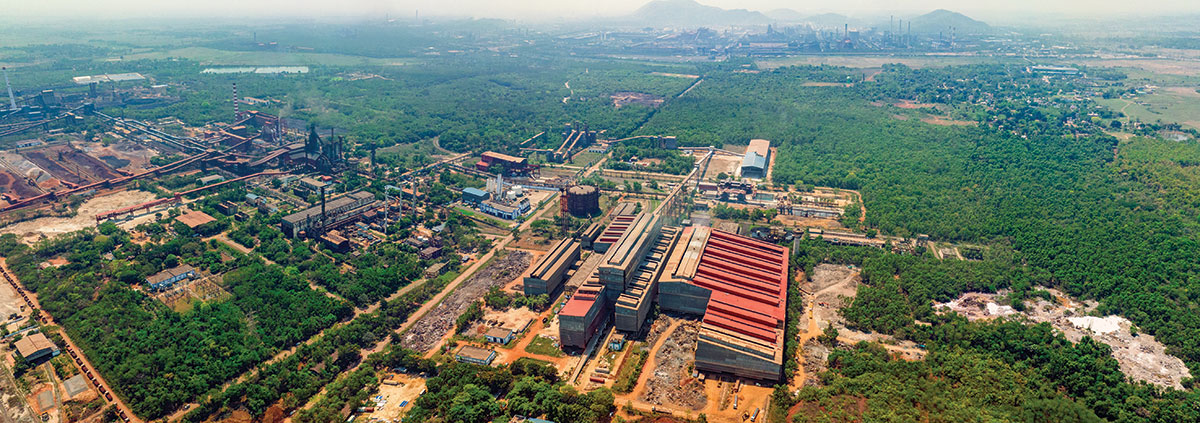
Aerial view of integrated steel plant
Driving sustainable value creation

Generation of capital

Tata Steel demonstrated financial resilience in FY2025-26 despite significant pricing pressure and macroeconomic uncertainties. Tata Steel reported a consolidated EBITDA of `34,848 crore for the year ended March 31, 2026, translating to a 35% increase y-o-y and reflecting the strength of its India operations, record deliveries, and continued improvement in its value-added and downstream portfolio. Consolidated EBITDA margins expanded to 15%, representing an improvement of 320 basis points y-o-y, underscoring the Company's emphasis on quality of earnings.

Operating cash flows before capex stood at `35,064 crore, resulting in `10,738 crore of free cash flows. This reflects disciplined capital deployment while prioritising execution of strategic growth projects. In addition, focused working capital initiatives released ~`5,442 crore of cash during the year, demonstrating internal funding capacity and enhancing financial flexibility.

A multi-geography cost transformation programme contributed materially to financial performance, delivering savings of `10,868 crore. These savings were achieved through raw-material efficiency, stores, repairs and maintenance cost optimisation, superior sales-mix management and supply-chain optimisation. Collectively, these initiatives strengthened margins, supported deleveraging, and enhanced cash flows.
Value creation

The Company remains the only Indian steel producer with dual international investment-grade ratings, retaining 'BBB (Stable)' from S&P Global Ratings and 'Baa3 (Stable)' from Moody's. These ratings reflect Tata Steel's scale, strong market position, robust India operations, and continued commitment to cost competitiveness. Domestic agencies further reaffirmed this strength, with India Ratings having been assigned 'AAA (Stable)' and CARE Ratings assigning 'AA+ (Stable)'.

The Company recorded a 24% y-o-y increase in market capitalisation to ~`2,39,210 crore as of March 31, 2026, signalling strong investor confidence in its long-term value-creation strategy. Value creation has been further supported by portfolio optimisation and consolidation initiatives, including the integration of subsidiaries and joint ventures across downstream and logistics operations, enabling synergy capture and improved capital efficiency.

~`2,39,210 crore Market capitalisation as of March 31, 2026
Delivering sustained value to stakeholders

Capital allocation

Capital allocation remained aligned with the Company's long-term strategy, centred on India-led volume growth, investments in downstream value-added capabilities, strengthening raw-material and supply-chain security, and advancing Europe's decarbonisation pathway in a phased manner. During the year, capex of `14,559 crore was deployed, with 60–70% allocated to India to progress key projects such as the Kalinganagar expansion, Combi Mill at Gamharia, Ludhiana EAF, and the growth project at NINL. Strategic investments in logistics, slurry pipelines, and distribution networks are strengthening cost competitiveness and improving market access.

In the Netherlands, Tata Steel signed a non-binding Letter of Intent (JLoI) with the Government of the Netherlands and the Province of North-Holland, outlining a collaborative approach on the Integrated Decarbonisation and Health measures project, with potential public funding upto €2 billion, subject to final agreements and satisfaction of conditions precedent on both sides.

In the UK, the Company has progressed its transition to low-emission steelmaking at Port Talbot with the execution of the 3.2 MTPA EAF project underway. Major demolition works are completed and construction activities and development of critical enabling infrastructure is underway.

Tata Steel continues to deliver sustained value to shareholders, recommending a dividend of `4.0 per equity share, extending its legacy of more than 85 years of uninterrupted dividend payouts.

`14,559 crore Capital expenditure in FY2025-26
2.3x Net Debt to EBITDA

Capital structure & management

Tata Steel has been funding its growth through strong internal cash generation with debt financing primarily used for short-term mismatches and refinancing needs.

As a result, the Company reported Net Debt of `80,144 crore, as on March 31, 2026. During FY2025-26, the Company proactively prepaid `7,556 crore of debt through internal accruals. Over the last two years, Net Debt to EBITDA improved significantly from ~3.3x to ~2.3x.

In line with its financing strategy, Tata Steel continued to onshore overseas debt, reducing exposure to currency volatility and strengthening the consolidated debt profile. As a result, overseas debt declined from ~50% of total debt in FY2020-21 to ~18% in FY2025-26. This proactive strategy mitigated the potential impact of currency depreciation by ~`12,500 crore. With a liquidity of `45,237 crore, including cash, cash equivalents, and undrawn credit lines, Tata Steel retains strong financial flexibility.

Strategic imperatives

The Company has outlined a capex plan of ~`20,000 crore for FY2026-27, with over 60% allocated to India, supported largely by internal accruals. The next phase of the cost transformation programme, targeting ~`7,100 crore of additional savings in FY2026-27, is underway to sustain margin improvement.

Tata Steel is also focused on increasing the share of value-added products towards ~50% of volumes over time, aiming to structurally enhance profitability and reduce cyclicality. Investments in low-emission technologies, including Hisarna and EAF-based steelmaking, are expected to further improve long-term capital efficiency and sustainability.

High impact strategic initiatives

Focused growth plans across the value chain
  • 4.8 MTPA Phase-I expansion at NINL enhancing the Company's presence in long-products segment and capitalising on growth in infrastructure and retail steel.
  • Strategic partnership with Lloyds Metals & Energy Limited to develop the emerging Gadchiroli iron ore hub and evaluate a phased greenfield steel capacity of 6 MTPA.
  • Acquisition of 50.01% in Thriveni Pellets Private Limited securing long-term pellet supply and enhancing raw-material integration.
Transition towards sustainable technologies
  • Inauguration of the 0.75 MTPA scrap-based Electric Arc Furnace at Ludhiana, Punjab (India).
  • Advancement of Hisarna and EASyMelt technologies.
  • Acquisition of Vattenfall power plants located in the IJmond region of the Netherlands, securing energy integration and supporting TSN's transition to low-emission steel production.
Downstream Value-added expansion
  • 2.5 MTPA Thin Slab Caster & Rolling facility at Meramandali expanding high-quality flat-steel output and reinforcing participation in automotive and white goods sectors.
  • Consolidated stake in Tata BlueScope (now Tata Steel Colors) to 100% to strengthen control over the high-margin colour-coated segment.
  • Commissioning of the Combi Mill in Jamshedpur, enhancing capability in specialty steel and value-added products.
  • 0.7 MTPA Hot Rolled Pickling & Galvanising Line at Tarapur — a first-of-its-kind facility in India, boosting the value-added portfolio and supporting import substitution.
  • Phase 1 expansion of Tinplate from 0.4 to 0.7 MTPA at Jamshedpur by FY2027-28.